Ancient Event on Town

If you want to find out what events are being or will be happening in your city, it's easy. now all the events that occurred in the city you are visiting the site can be known by ticketamerica.com

Sporting events, music concerts, or major event Others can be easily recognized by ticketamerica.com site, other than that if we want to get tickets for the event is also very easy to just click and tickets will be sent to you as soon as possible.

so wait no more, let in droves to buy tickets event we already waiting in our city right now.

Big cities in America that has been supported by ticketamerica.com include:

Las Vegas
Phoenix
Dallas
Boston
New York
Washington

American Football Tickets

American Football Tickets can now be obtained in www.ticketamerica.com, no need to queue for hours to watch the spectacular matches or big-match in the counter-counter traditional, just take a moment and message in www.ticketamerica.com tickets then we can get tickets america football league that we want.

Very easy and helpful. We can book tickets game today for game tommorow. so please immediately booked tickets to your favorite team. not to be missed.

Match tickets of Dallas Cowboys, Washington Redskins, Chicago Bears, New York Giants, and all the teams who follow the league can be found here. Don't missed the action of your favorite player. Be the good supporters, buy the tickets and support your team.

iPad's History

The iPad is a computing device, developed by Apple, meant for internet browsing, media consumption and light content creation. Released in April 2010, it is considered to have introduced a class of devices between smartphones, and laptops.

Like the older iPod Touch and IPhone devices, the larger iPad runs the iPhone OS operating system and uses a multi-touch LCD display for most user interactions. It runs iPad-specific applications as well as ones written for the iPod touch and iPhone, including e-book readers.

The iPad uses wireless connections — WiFi or a 3G cellular network — to browse the internet, load and stream media, and install software.

Apple's first tablet computer was the Newton MessagePad 100, introduced in 1993, which led to the creation of the ARM6 processor core with Acorn Computers. Apple also developed a prototype PowerBook Duo-based tablet, the PenLite, but did not sell it to avoid hurting MessagePad sales. Apple released several more Newton-based PDAs, and discontinued the last, the MessagePad 2100, in 1998.

Apple reentered the mobile-computing market in 2007 with the iPhone. Smaller than the iPad but featuring a camera and mobile phone, it pioneered the multitouch interface of iPhone OS. By late 2009, the iPad's release had been rumored for several months; iSlate and iTablet were among speculated names. The iPad was announced on January 27, 2010 by Steve Jobs at an Apple press conference at the Yerba Buena Center for the Arts in San Francisco.

Three days later, at the 52nd Grammy Awards, Stephen Colbert used an iPad in announcing the nominees.

Apple began taking pre-orders for the iPad from U.S. customers on March 12, 2010. The Wi-Fi version of the iPad went on sale in the United States on April 3, 2010, at 9:00 am local time, with hundreds of customers lined up outside stores nationwide. The Wi-Fi + 3G version will be released at the end of April. The iPad will also be available in Australia, Canada, France, Germany, Italy, Japan, Spain, Switzerland and the UK beginning in late May.[26] 3G service in the United States will be provided by AT&T and sold with two prepaid contract-free data plan options: one for unlimited data and the other for 250 MB per month at half the price. The plans will be activated on the iPad itself and can be canceled at any time.

Like the iPhone, the iPad shares its name with existing products. The most publicized is the Fujitsu iPAD, a mobile multi-functional device sold to retailers to help clerks verify prices, check inventory, and close sales. The Japanese company Fujitsu introduced the iPAD in 2002, and the following year applied for the trademark, but the firm found the mark was already owned by Mag-Tek. Fujitsu's trademark application was listed as "abandoned" in April 2009, and the ownership of the mark is unclear. Fujitsu consulted attorneys over what, if any, action it may take. On March 17, 2010 the Fujitsu IPAD U.S. trademark was transferred to Apple.

In the first days after the iPad's announcement, some media and many online commenters criticized the name "iPad", noting its similarity to "pad", the common name for a sanitary napkin. Shortly after the launch announcement, the hashtag "iTampon" became the number-two trending topic on the social networking site Twitter.

Outline of Railroad History

Roads of rails called Wagonways were being used in Germany as early as 1550. These primitive railed roads consisted of wooden rails over which horse-drawn wagons or carts moved with greater ease than over dirt roads. Wagonways were the beginnings of modern railroads.

By 1776, iron had replaced the wood in the rails and wheels on the carts. Wagonways evolved into Tramways and spread though out Europe. Horses still provided all the pulling power. In 1789, Englishman, William Jessup designed the first wagons with flanged wheels. The flange was a groove that allowed the wheels to better grip the rail, this was an important design that carried over to later locomotives.

The invention of the steam engine was critical to the invention of the modern railroad and trains. In 1803, a man named Samuel Homfray decided to fund the development of a steam-powered vehicle to replace the horse-drawn carts on the tramways. Richard Trevithick (1771-1833) built that vehicle, the first steam engine tramway locomotive. On February 22, 1804, the locomotive hauled a load of 10 tons of iron, 70 men and five extra wagons the 9 miles between the ironworks at Pen-y-Darron in the town of Merthyr Tydfil, Wales to the bottom of the valley called Abercynnon. It took about two hours.

In 1821, Englishman, Julius Griffiths was the first person to patent a passenger road locomotive.

In September, 1825, the Stockton & Darlington Railroad Company began as the first railroad to carry both goods and passengers on regular schedules using locomotives designed by English inventor, George Stephenson. Stephenson's locomotive pulled six loaded coal cars and 21 passenger cars with 450 passengers over 9 miles in about one hour.

George Stephenson is considered to be the inventor of the first steam locomotive engine for railways. Richard Trevithick's invention is considered the first tramway locomotive, however, it was a road locomotive, designed for a road and not for a railroad. Stephenson was extremely poor growing up and received little formal education. He worked in local collieries and was self-taught in reading and writing. In 1812, he became a colliery engine builder, and in 1814 he built his first locomotive for the Stockton and Darlington Railway Line. Stephenson was hired as the company engineer and soon convinced the owners to use steam motive power and built the line's first locomotive, the Locomotion. In 1825, Stephenson moved to the Liverpool and Manchester Railway, where together with his son Robert built (1826-29) the Rocket.

Colonel John Stevens is considered to be the father of American railroads. In 1826 Stevens demonstrated the feasibility of steam locomotion on a circular experimental track constructed on his estate in Hoboken, New Jersey, three years before George Stephenson perfected a practical steam locomotive in England. The first railroad charter in North America was granted to John Stevens in 1815. Grants to others followed, and work soon began on the first operational railroads.

Designed and built by Peter Cooper in 1830, the Tom Thumb was the first American-built steam locomotive to be operated on a common-carrier railroad.

The Pullman Sleeping Car was invented by George Pullman in 1857. Pullman's railroad coach or sleeper was designed for overnight passenger travel. Sleeping cars were being used on American railroads since the 1830s, however, early sleepers were not that comfortable and the Pullman Sleeper was very comfortable.

Advanced Train Systems
In the 1960s and early 1970s, considerable interest developed in the possibility of building tracked passenger vehicles that could travel much faster than conventional trains. From the 1970s, interest in an alternative high-speed technology centered on magnetic levitation, or maglev. This vehicle rides on an air cushion created by electromagnetic reaction between an on-board device and another embedded in its guideway.

Aviation Story: The Wright Brothers

Following a step by step method, discovering aerodynamic forces then controlling the flight, the brothers built and tested a series of kite and glider designs from 1900 to 1902 before attempting to build a powered design. The gliders worked, but not as well as the Wrights had expected based on the experiments and writings of their 19th century predecessors. Their first glider, launched in 1900, had only about half the lift they anticipated. Their second glider, built the following year, performed even more poorly. Rather than giving up, the Wrights constructed their own wind tunnel and created a number of sophisticated devices to measure lift and drag on the 200 wing designs they tested. As a result, the Wrights corrected earlier mistakes in calculations regarding drag and lift. Their testing and calculating produced a third glider with a larger aspect ratio and true three-axis control. They flew it successfully hundreds of times in 1902, and it performed far better than the previous models. In the end, by establishing their rigorous system of designing, wind-tunnel testing of airfoils and flight testing of full-size prototypes, the Wrights not only built a working aircraft but also helped advance the science of aeronautical engineering.

The Wrights appear to be the first design team to make serious studied attempts to simultaneously solve the power and control problems. Both problems proved difficult, but they never lost interest. They solved the control problem by inventing wing warping for roll control, combined with simultaneous yaw control with a steerable rear rudder. Almost as an afterthought, they designed and built a low-powered internal combustion engine. Relying on their wind tunnel data, they also designed and carved wooden propellers that were more efficient than any before, enabling them to gain adequate performance from their marginal engine power. Although wing-warping was used only briefly during the history of aviation, when used with a rudder it proved to be a key advance in order to control an aircraft. While many aviation pioneers appeared to leave safety largely to chance, the Wrights' design was greatly influenced by the need to teach themselves to fly without unreasonable risk to life and limb, by surviving crashes. This emphasis, as well as marginal engine power, was the reason for low flying speed and for taking off in a head wind. Performance (rather than safety) was also the reason for the rear-heavy design, because the canard could not be highly loaded; anhedral wings were less affected by crosswinds and were consistent with the low yaw stability.

According to the Smithsonian Institution and Fédération Aéronautique Internationale (FAI), the Wrights made the first sustained, controlled, powered heavier-than-air manned flight at Kill Devil Hills, North Carolina, four miles (8 km) south of Kitty Hawk, North Carolina on December 17, 1903.

The first flight by Orville Wright, of 120 feet (37 m) in 12 seconds, was recorded in a famous photograph. In the fourth flight of the same day, Wilbur Wright flew 852 feet (260 m) in 59 seconds. The flights were witnessed by three coastal lifesaving crewmen, a local businessman, and a boy from the village, making these the first public flights and the first well-documented ones.

Orville described the final flight of the day: "The first few hundred feet were up and down, as before, but by the time three hundred feet had been covered, the machine was under much better control. The course for the next four or five hundred feet had but little undulation. However, when out about eight hundred feet the machine began pitching again, and, in one of its darts downward, struck the ground. The distance over the ground was measured to be 852 feet (260 m); the time of the flight was 59 seconds. The frame supporting the front rudder was badly broken, but the main part of the machine was not injured at all. We estimated that the machine could be put in condition for flight again in about a day or two." They flew only about ten feet above the ground as a safety precaution, so they had little room to maneuver, and all four flights in the gusty winds ended in a bumpy and unintended "landing".

The Wrights continued flying at Huffman Prairie near Dayton, Ohio in 1904–05. After a severe crash on 14 July 1905, they rebuilt the Flyer and made important design changes. They almost doubled the size of the elevator and rudder and moved them about twice the distance from the wings. They added two fixed vertical vanes(called "blinkers") between the elevators, and gave the wings a very slight dihedral. They disconnected the rudder from the wing-warping control, and as in all future aircraft, placed it on a separate control handle. When flights resumed the results were immediate. The serious pitch instability that hampered Flyers I and II was significantly reduced, so repeated minor crashes were eliminated. Flights with the redesigned Flyer III started lasting over 10 minutes, then 20, then 30. Flyer III became the first practical aircraft (though without wheels and needing a launching device), flying consistently under full control and bringing its pilot back to the starting point safely and landing without damage. On 5 October 1905, Wilbur flew 24 miles (38.9 km) in 39 minutes 23 seconds."

According to the April 1907 issue of the Scientific American magazine, the Wright brothers seemed to have the most advanced knowledge of heavier-than-air navigation at the time. Though, the same magazine issue also affirms that no public flight has been made in the United States before its April 1907 issue. Hence, they devised the Scientific American Aeronautic Trophy in order to encourage the development of a heavier-than-air flying machine.

Electricity, What is that?

Electricity (from the Greek word ἤλεκτρον, (elektron), meaning amber, and finally from New Latin ēlectricus, "amber-like") is a general term that encompasses a variety of phenomena resulting from the presence and flow of electric charge. These include many easily recognizable phenomena such as lightning and static electricity, but in addition, less familiar concepts such as the electromagnetic field and electromagnetic induction. In general usage, the word 'electricity' is adequate to refer to a number of physical effects. However, in scientific usage, the term is vague, and these related, but distinct, concepts are better identified by more precise terms:
* Electric charge –
a property of some subatomic particles, which determines their electromagnetic interactions. Electrically charged matter is influenced by, and produces, electromagnetic fields.


* Electric current –
a movement or flow of electrically charged particles, typically measured in amperes.


* Electric field –
an influence produced by an electric charge on other charges in its vicinity.


* Electric potential –
the capacity of an electric field to do work on a electric charge, typically measured in volts.


* Electromagnetism –
a fundamental interaction between the magnetic field and the presence and motion of an electric charge.


Electrical phenomena have been studied since antiquity, though advances in the science were not made until the seventeenth and eighteenth centuries. Practical applications for electricity however remained few, and it would not be until the late nineteenth century that engineers were able to put it to industrial and residential use. The rapid expansion in electrical technology at this time transformed industry and society. Electricity's extraordinary versatility as a source of energy means it can be put to an almost limitless set of applications which include transport, heating, lighting, communications, and computation. The backbone of modern industrial society is, and for the foreseeable future can be expected to remain, the use of electrical power.

The History of Computer

The first computers were people! That is, electronic computers (and the earlier mechanical computers) were given this name because they performed the work that had previously been assigned to people. "Computer" was originally a job title: it was used to describe those human beings (predominantly women) whose job it was to perform the repetitive calculations required to compute such things as navigational tables, tide charts, and planetary positions for astronomical almanacs. Imagine you had a job where hour after hour, day after day, you were to do nothing but compute multiplications. Boredom would quickly set in, leading to carelessness, leading to mistakes. And even on your best days you wouldn't be producing answers very fast. Therefore, inventors have been searching for hundreds of years for a way to mechanize (that is, find a mechanism that can perform) this task.

This picture shows what were known as "counting tables" [photo courtesy IBM]

A typical computer operation back when computers were people.

The abacus was an early aid for mathematical computations. Its only value is that it aids the memory of the human performing the calculation. A skilled abacus operator can work on addition and subtraction problems at the speed of a person equipped with a hand calculator (multiplication and division are slower). The abacus is often wrongly attributed to China. In fact, the oldest surviving abacus was used in 300 B.C. by the Babylonians. The abacus is still in use today, principally in the far east. A modern abacus consists of rings that slide over rods, but the older one pictured below dates from the time when pebbles were used for counting (the word "calculus" comes from the Latin word for pebble).

A very old abacus

A more modern abacus. Note how the abacus is really just a representation of the human fingers: the 5 lower rings on each rod represent the 5 fingers and the 2 upper rings represent the 2 hands.

In 1617 an eccentric (some say mad) Scotsman named John Napier invented logarithms, which are a technology that allows multiplication to be performed via addition. The magic ingredient is the logarithm of each operand, which was originally obtained from a printed table. But Napier also invented an alternative to tables, where the logarithm values were carved on ivory sticks which are now called Napier's Bones.

An original set of Napier's Bones [photo courtesy IBM]

A more modern set of Napier's Bones

Napier's invention led directly to the slide rule, first built in England in 1632 and still in use in the 1960's by the NASA engineers of the Mercury, Gemini, and Apollo programs which landed men on the moon.

A slide rule

Leonardo da Vinci (1452-1519) made drawings of gear-driven calculating machines but apparently never built any.

A Leonardo da Vinci drawing showing gears arranged for computing

The first gear-driven calculating machine to actually be built was probably the calculating clock, so named by its inventor, the German professor Wilhelm Schickard in 1623. This device got little publicity because Schickard died soon afterward in the bubonic plague.

Schickard's Calculating Clock

In 1642 Blaise Pascal, at age 19, invented the Pascaline as an aid for his father who was a tax collector. Pascal built 50 of this gear-driven one-function calculator (it could only add) but couldn't sell many because of their exorbitant cost and because they really weren't that accurate (at that time it was not possible to fabricate gears with the required precision). Up until the present age when car dashboards went digital, the odometer portion of a car's speedometer used the very same mechanism as the Pascaline to increment the next wheel after each full revolution of the prior wheel. Pascal was a child prodigy. At the age of 12, he was discovered doing his version of Euclid's thirty-second proposition on the kitchen floor. Pascal went on to invent probability theory, the hydraulic press, and the syringe. Shown below is an 8 digit version of the Pascaline, and two views of a 6 digit version:

Pascal's Pascaline [photo © 2002 IEEE]

A 6 digit model for those who couldn't afford the 8 digit model

A Pascaline opened up so you can observe the gears and cylinders which rotated to display the numerical result
(Arranged by John Kopplin)

The Influence of Car

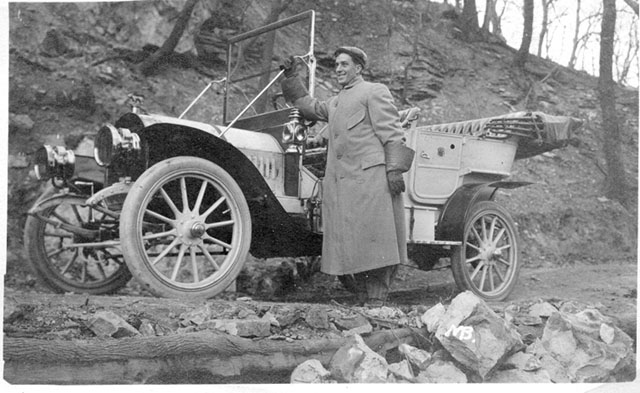
In 1903, in Winfield, Kansas Mr. H. T. Trice is seen standing in from of the first car in town. Acutally it was more like a truck and was used to haul customers out to see land. The railroads brought potential customers to town and Mr. Trice picked them up at the depot and took them out to his new developements.

Steam power was widely used in the 1880's and 1890's on the farms of America. Cowley County had its share of these behemoths and had a large group of people with the ability to use, and the skill to fix and repair them. The smaller, less expensive automobile, with an internal combustion engine provided a new avenue of interest that was much more personal than the steam engine with its team of attendents.

Mr. Martin Baden of Winfield, Kansas and his new eight-cylinder Cadillac roadster. This car was especially built for Mr. Baden, and was equipped with all modern appliances. Driving an automobile required a high degree to technical dexterity, mechanical skill, special clothing including hat, gloves, duster coat, goggles and boots. Tires were notoriously unreliable and changing one was an excruciating experience. Fuel was a problem, since gasoline was in short supply. Mr. Baden became interested enough to become a self-taught geologist and eventually discover major oil deposits in Cowley County, Kansas, and surrounding area.

The drivers of the day were an adventurous lot, going out in every kind of weather, unprotected by an enclosed body, or even a convertible top. Everyone in town knew who owned what car and the cars were soon to become each individuals token of identity. Notice the guy at the far right fixing his flat time. The dirt roads were a challange in any weather. By 1910 Winfield paved the downtown streets with brick, horses were no longer welcome. The mule drawn trolleys were upgraded to electric streetcars.

By 1915 racing had become a passion all over the United States. A typical local race track was at the Cowley County Fairgounds in Winfield, Kansas. The local obsession with horse racing, started by the earliest settlers in 1870, turned to the new technology of auto racing. Local farm boys who were familiar with motors and equipment used their talents on cars and motorcycles to go faster than anyone in the county.

The horse racing facilities were quickly converted to the new, faster, more dangerous, and thus more exciting, motor racing. See Bob Lawrence's Home Page for new sections on both Auto Racing and Motorcycle Racing in Cowley County, Kansas

Eventually the automobile change the face of small town America. The town gentry bought cars, albiet fashoned to match their station in life. In Winfield, Kansas, Main Street went from a gathering place for people and horses and wagons to a parking place for the ubiquitous automobile. The Trolley Cars were displaced to make room for more cars. The brick streets were covered with asphalt to provide a smoother ride for the automobile. The old fire maps of Winfield show the inexorable spread of the automobile and all of the supporting businesses. Filling stations, auto dealers, battery stations, oil depots all grew and expanded to displace to older technologies of the day. R. B. Sandfords Winfield Carriage Works appears on the firemap of Block 127 in 1918. But on the same spot on Block 127 in 1925 it has been replaced by a Battery Station and an Auto Storage facility.

Midway through the century, cars had become a central feature of life for young people. The cars owned by the students of Winfield High School in the fifties are typical of every where in America at that time. It was mobility, status, challenge, and social freedom. It certainly hurt our football team at the time. A typical excuse for not playing on the football team was that a student had to work to earn money to pay for their car. When asked why they needed a car, the answer was invariably: to get to work!

After a century of the automobile, we can begin to assess the effects of long term transport by internal combustion. Nearly every aspect of our lives has developed around this technology. Only now, are we seeing new digital communications technologies, of the internet and beyond, that may eventually displace some of the functions of the automobile and replace our current problems with a new set that you, our grandchildren, will be charged with solving. Ask your grandparents about their first car. I'm sure you will get to hear a great story.
(Arranged by William W. Bottorff)

Car History

cugnots.jpg

Several Itialians recorded designs for wind driven vehicles. The first was Guido da Vigevano in 1335. It was a windmill type drive to gears and thus to wheels. Vaturio designed a similar vehicle which was also never built. Later Leonardo da Vinci designed a clockwork driven tricycle with tiller steering and a differential mechanism between the rear wheels.

A Catholic priest named Father Ferdinand Verbiest has been said to have built a steam powered vehicle for the Chinese Emporer Chien Lung in about 1678. There is no information about the vehicle, only the event. Since Thomas Newcomen didn't build his first steam engine until 1712 we can quess that this was possibly a model vehicle powered by a mechanism like Hero's steam engine, a spining wheel with jets on the periphery. Newcomen's engine had a cylinder and a piston and was the first of this kind, and it used steam as a condensing agent to form a vacuum and with an overhead walking beam, pull on a rod to lift water. It was an enormous thing and was strictly stationary. The steam was not under pressure, just an open boiler piped to the cylinder. It used the same vacuum principle that Thomas Savery had patened to lift water directly with the vacuum, which would have limited his pump to less than 32 feet of lift. Newcomen's lift would have only been limited by the length of the rod and the strength of the valve at the bottom. Somehow Newcomen was not able to seperate his invention from that of Savery and had to pay for Savery's rights. In 1765 James Watt developed the first pressurized steam engine which proved to be much more efficient and compact that the Newcomen engine.

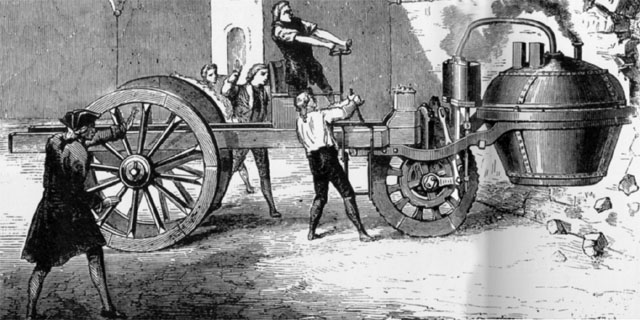
The first vehicle to move under its own power for which there is a record was designed by Nicholas Joseph Cugnot and constructed by M. Brezin in 1769. A replica of this vehicle is on display at the Conservatoire des Arts et Metiers, in Paris. I believe that the Smithsonian Museum in Washington D. C. also has a large (half size ?) scale model. A second unit was built in 1770 which weighed 8000 pounds and had a top speed on 2 miles per hour and on the cobble stone streets of Paris this was probably as fast as anyone wanted to go it. The picture shows the first model on its first drive around Paris were it hit and knocked down a stone wall. It also had a tendency to tip over frontwards unless it was conterweighted with a canon in the rear. the purpose of the vehicle was to haul canons around town.

The early steam powered vehicles were so heavy that they were only practical on a perfectly flat surface as strong as iron. A road thus made out of iron rails became the norm for the next hundred and twenty five years. The vehicles got bigger and heavier and more powerful and as such they were eventually capable of pulling a train of many cars filled with freight and passengers.

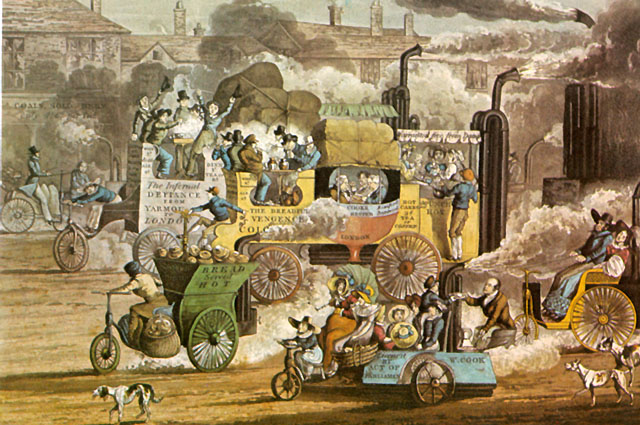
As the picture at the right shows, many attempts were being made in England by the 1830's to develop a practical vehicle that didn't need rails. A series of accidents and propaganda from the established railroads caused a flurry of restrictive legislation to be passed and the development of the automobile bypassed England. Several commercial vehicles were built but they were more like trains without tracks.

The development of the internal combustion engine had to wait until a fuel was available to combust internally. Gunpowder was tried but didn't work out. Gunpowder carburetors are still hard to find. The first gas really did use gas. They used coal gas generated by heating coal in a pressure vessel or boiler. A frenchman named Etienne Lenoir patented the first pratical gas engine in Paris in 1860 and drove a car based on the design from Paris to Joinville in 1862. His one-half horse power engine had a bore of 5 inches and a 24 inch stroke. It was big and heavy and turned 100 rpm. Lenoir died broke in 1900.

Lenoir had a seperate mechanism to compress the gas before combustion. In 1862, Alphonse Bear de Rochas figured out how to compress the gas in the same cylinder in which it was to burn, which is the way we still do it. This process of bringing the gas into the cylinder, compressing it, combusting the compressed mixture, then exhausting it is know as the Otto cycle, or four cycle engine. Lenoir claimed to have run the car on benzine and his drawings show an electric spark ignition. If so, then his vehicle was the first to run on petroleum based fuel, or petrol, or what we call gas, short for gasoline.

Siegfried Marcus, of Mecklenburg, built a can in 1868 and showed one at the Vienna Exhibition of 1873. His later car was called the Strassenwagen had about 3/4 horse power at 500 rpm. It ran on crude wooden wheels with iron rims and stopped by pressing wooden blocks against the iron rims, but it had a clutch, a differential and a magneto ignition. One of the four cars which Marcus built is in the Vienna Technical Museum and can still be driven under its own power.

In 1876, Nokolaus Otto patented the Otto cycle engine, de Rochas had neglected to do so, and this later became the basis for Daimler and Benz breaking the Otto patent by claiming prior art from de Rochas.

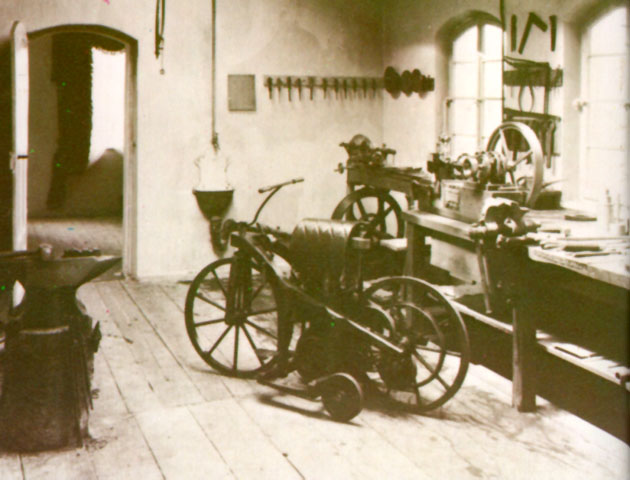
The picture to the left, taken in 1885, is of Gottllieb Daimler's workshop in Bad Cannstatt where he built the wooden motorcycle shown. Daimler's son Paul rode this motorcycle from Cannstatt to Unterturkheim and back on November 10, 1885. Daimler used a hot tube ignition system to get his engine speed up to 1000 rpm

The previous August, Karl Benz had already driven his light, tubular framed tricycle around the Neckar valley, only 60 miles from where Daimler lived and worked. They never met. Frau Berta Benz took Karl's car one night and made the first long car trip to see her mother, traveling 62 miles from Mannheim to Pforzheim in 1888.

Also in August 1888, William Steinway, owner of Steinway & Sons piano factory, talked to Daimler about US manufacturing right and by September had a deal. By 1891 the Daimler Motor Company, owned by Steinway, was producing petrol engines for tramway cars, carriages, quadricycles, fire engines and boats in a plant in Hartford, CT.

Steam cars had been built in America since before the Civil War but the early one were like miniture locomotives. In 1871, Dr. J. W. Carhart, professor of physics at Wisconsin State University, and the J. I. Case Company built a working steam car. It was practical enough to inspice the State of Wisconsin to offer a $10,000 prize to the winner of a 200 mile race in 1878.>

The 200 mile race had seven entries, or which two showed up for the race. One car was sponsored by the city of Green Bay and the other by the city of Oshkosh. The Green Bay car was the fastest but broke down and the Oshkosh car finished with an average speed of 6 mph.

From this time until the end of the century, nearly every community in America had a mad scientist working on a steam car. Many old news papers tell stories about the trials and failures of these would be inventors.

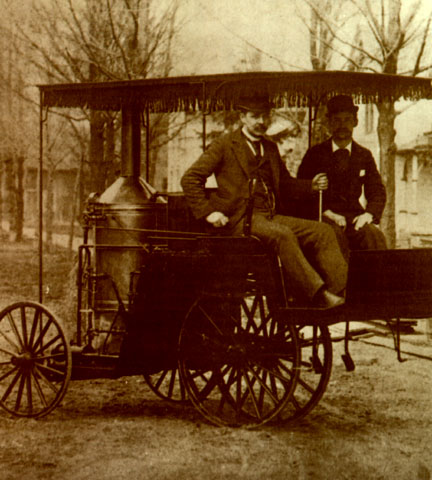
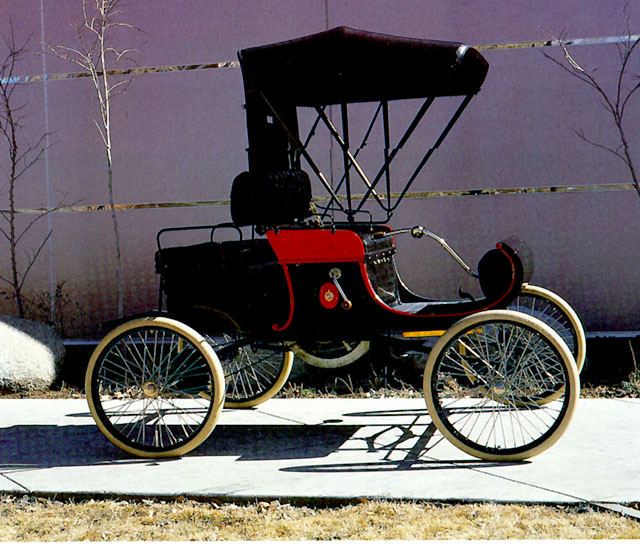
By 1890 Ransom E. Olds had built his second steam powered car, pictured at left. One was sold to a buyer in India, but the ship it was on was lost at sea.

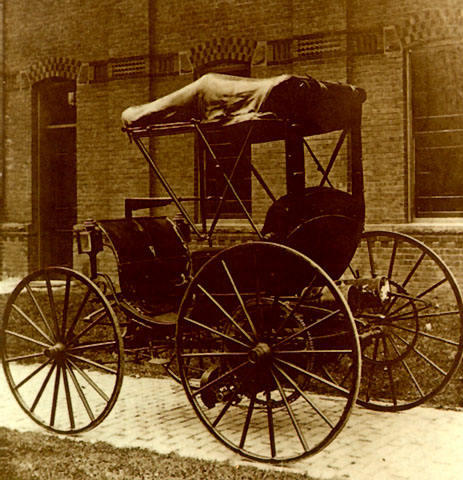
Running by February, 1893 and ready for road trials by September, 1893 the car built by Charles and Frank Duryea, brothers, was the first gasoline powered car in America. The first run on public roads was made on September 21, 1893 in Springfield, MA. They had purchased a used horse drawn buggy for $70 and installed a 4 HP, single cylinder gasoline engine. The car (buggy) had a friction transmission, spray carburetor and low tension ignition. It must not have run very well because Frank didn't drive it again until November 10 when it was reported by the Springfield Morning Union newspaper. This car was put into storage in 1894 and stayed there until 1920 when it was rescued by Inglis M. Uppercu and presented to the United States National Museum.

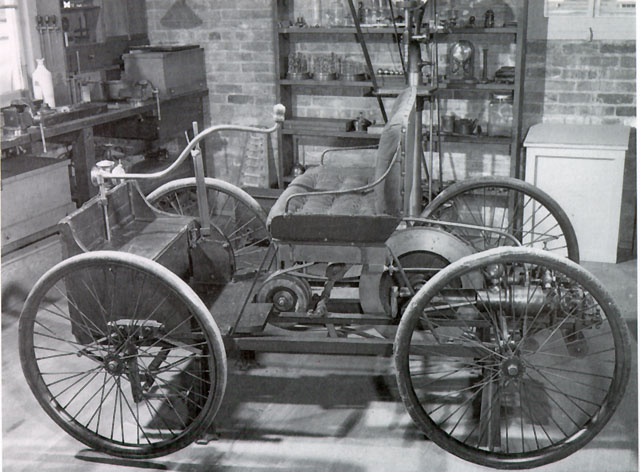
Henry Ford had an engine running by 1893 but it was 1896 before he built his first car. By the end of the year Ford had sold his first car, which he called a Quadracycle, for $200 and used the money to build another one. With the financial backing of the Mayor of Detroit, William C. Maybury and other wealthy Detroiters, Ford formed the Detroit Automobile Company in 1899. A few prototypes were built but no production cars were ever made by this company. It was disolved in January 1901. Ford would not offer a car for sale until 1903.

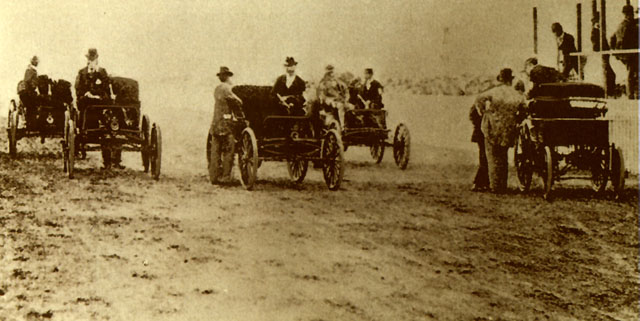
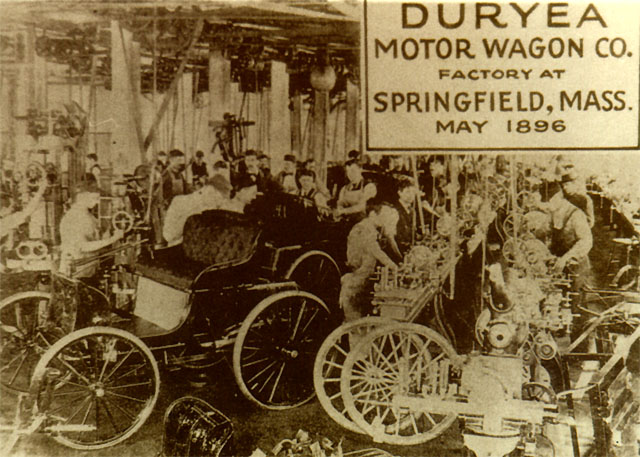
The first closed circuit automobile race held at Narragansett Park, Rhode Island, in September 1896. All four cars to the left are Duryeas, on the right is a Morris & Salom Electrobat. Thirteen Duryeas of the same design were produced in 1896, making it the first production car.

At left is pictured the factory with produced the 13 Duryeas. In 1898 the brothers went their seperate ways and the Duryea Motor Wagon Company was closed. Charles, who was born in 1861 and was eight years older than Frank had taken advantage of Frank in publicity and patents. Frank went out on his own and eventually joined with Stevens Arms and Tool Company to form the Stevens-Duryea Company which was sold to Westinghouse in 1915. Charles tried to produce some of his own hare-brained ideas with various companies until 1916. Thereafter he limited himself to writing technical book and articles. He died in 1938. Frank got a half a million dollars for the Westinghouse deal and lived in comfort until his death in 1967, just seven months from his 98th birthday.

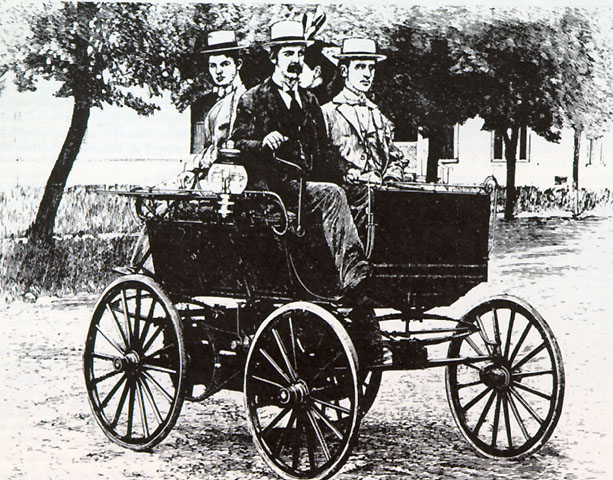
In this engraving Ransom Eli Olds is at the tiller of his first petrol powered car. Riding beside him is Frank G. Clark, who built the body and in the back are their wives. This car was running by 1896 but production of the Olds Motor Vehicle Company of Detroit did not begin until 1899. After an early failure with luxury vehicles they established the first really successful production with the classic Curved Dash Oldsmobile.

The Curved Dash Oldsmobile had a single cylinder engine, tiller steering and chain drive. It sold for $650. In 1901 600 were sold and the next years were 1902 - 2,500, 1903 - 4,000, 1904 - 5,000. In August 1904 Ransom Olds left the company to form Reo (for Ransom Eli Olds). Ransom E. Olds was the first mass producer of gasoline powered automobiles in the United States, even though Duryea was the first auto manufacturer with their 13 cars.

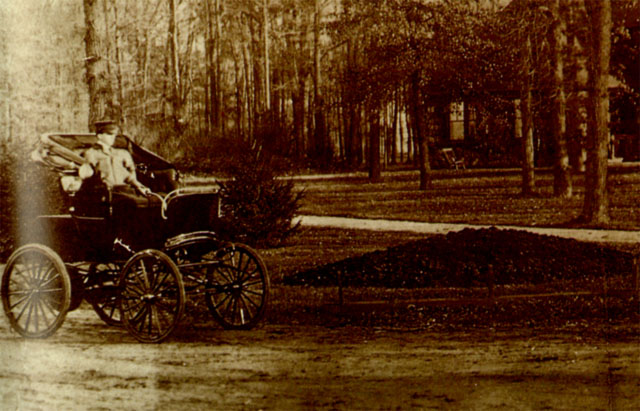
Ransom Olds produced a small number of electric cars around the turn of the century. Little is known about them and none survive. The picture ar left is the only known picture of one of these rare cars. It was taken at was taken at Belle Island Park, Michigan. In 1899 and 1900, electrics outsold all other type of cars and the most popular electric was the Columbia built by Colonel Albert Augustus Pope, owner of American Bicycle Company.
an interesting footnote to the Olds electric.

J. A. Koosen and H. Lawson in a 1895 Lutzmann. This is typical of American design in the mid 1890's. It was truly a horseless carriage. Tiller steering, engine under the floorboards, very high center of gravity, not designed for road travel. Imagine climbing into one of these and trying to drive across town and around a few corners. Kind of scary, huh?

This Daimler of 1899 was owned by Lionel Rothcheld. The european design is much advanced of the American designs of the same time. Gottlieb Daimler took part in the London-to-Brighton run in 1896 but died in 1900 at the age of 66 without ever meeting Benz. His German engines powered the automobile industries of Britian and France.

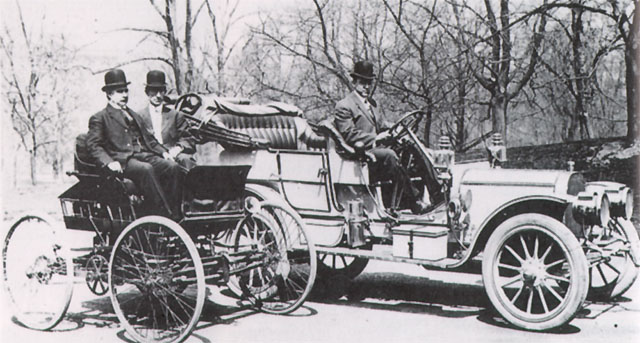
The 1908 Haynes in the back ground shows the rapid development of the petrol powered car when compared to the 1894 model in the forground. Consider the present difference between a 1998 Tarus and the 14 year old 1984 Tarus. Some difference. Old man Haynes claimed to have build the 1894 car in 1893 but had no proof.

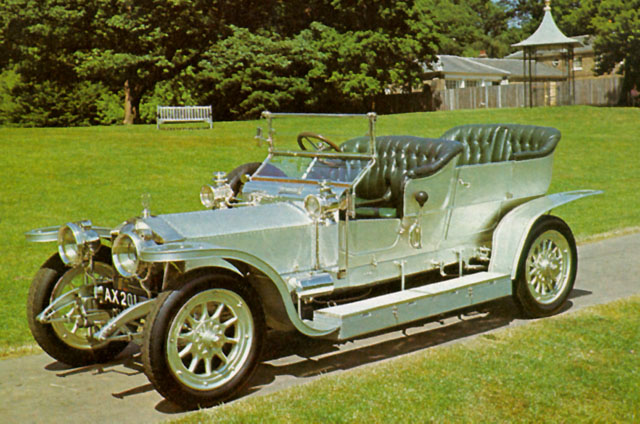
The Rolls Royce Silver Ghost of 1906 was a six cylinder car that stayed in production until 1925. It represented the best engineering and technology available at the time and these cars still run smoothly and silently today. This period marked the end of the beginning of the automobile.
(Arranged by William W. Bottorff)